
You did not sign up for this. You got into this relationship because you trusted this person. And now something happened, maybe an affair, maybe a pattern of lies, maybe something that cuts even deeper, and the relationship you thought you had feels like it's been replaced by something you don't recognize.
You're not just hurt. You're triggered. You're hypervigilant. You're scanning your partner's face for clues. You replay the same moments over and over, even when you don't want to. If that sounds familiar, you might be dealing with betrayal trauma, and it's real, it's recognized, and it's treatable.
Here's the hard part, though: regular couples therapy often isn't built for these situations. Standard communication tools, like "use I statements" or "listen without interrupting," break down when one or both of you get caught in a trauma response. Your nervous system is in control, and no worksheet is going to fix that.
That's where Gottman Method Couples Therapy for Trauma comes in. It's not a feel-good framework. It's a structured, research-backed approach that was specifically designed to handle the mess that trauma makes of a relationship.
Why Betrayal Trauma Is Different From Regular Relationship Conflict
Most couples argue about dishes, money, and whose turn it is to call the plumber. Betrayal trauma is something else entirely.
When your partner betrays your trust at a fundamental level, your brain processes it much like it processes a physical threat. According to research from Dr. John Gottman, who has studied couples for over 40 years, a betrayed partner can develop PTSD-like symptoms: intrusive thoughts, hypervigilance, emotional flooding, and even dissociation. The betrayed partner might experience flashbacks to moments of betrayal or feel constantly "on guard," searching for signs of further dishonesty. This heightened state can bring on irritability, mood swings, and a sense of helplessness.
This response is not dramatic. This is your nervous system doing exactly what it's supposed to do when safety is threatened. The problem is that those same survival responses, fight, flight, freeze, and fawn, make healing as a couple almost impossible without the right support.
Standard couples therapy often skips past this layer. It assumes both people can access their rational thinking and communicate clearly. But when trauma is in the room, that assumption fails before the first session is over.
What Is Gottman Method Couples Therapy for Trauma, Really?
Gottman Method Couples Therapy for Trauma is not just the classic Gottman approach with a trauma disclaimer tacked on. It's a clinical integration of relationship science and trauma-informed treatment.
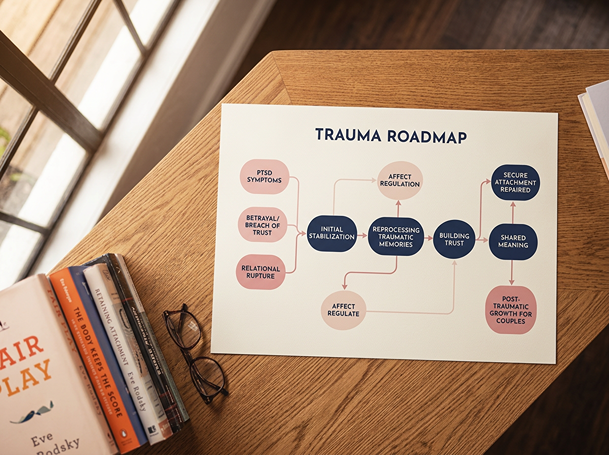
Drs. John and Julie Gottman developed what they call the "Atone, Attune, and Attach" model specifically for couples dealing with affairs and betrayal. This model provides therapists with an unbiased roadmap to compassionately serve both partners as they struggle to rebuild a collapsed relationship, and it was built from real clinical work with couples experiencing both PTSD and infidelity.
Here's what that looks like in practice, broken into three broad phases:
Phase 1: Safety and Stabilization (Atone)
Before any repair work can happen, the relationship has to become emotionally safe enough for both of you to stay in the room. This phase is when a Gottman therapist specializing in trauma demonstrates their value.
This is not about forgiving quickly or "moving past it." It's about the betraying partner taking full, unambiguous accountability. No minimizing. No explaining why it happened, as if that cancels it out. Just a clear acknowledgment of the harm done.
Dr. Gottman emphasizes that rebuilding trust requires transparency, honesty, and a commitment to open dialogue about the betrayal. Without this foundation, nothing that follows will stick.
Your therapist will also help you both understand your nervous systems. You'll learn to recognize when you're flooded, when your brain has essentially gone offline, and what to do when that happens before the conversation collapses into another fight.
Phase 2: Processing and Understanding (Attune)
Once there's enough stability, the work shifts to understanding what actually happened and why. Not as an excuse, but as a shared map.
The Gottman method includes a framework showing how couples can drift toward betrayal through a cascade of small disconnections, blurring boundaries gradually over time. Understanding that cascade helps both partners see the full picture, which is painful but less crazy-making than trying to make sense of it alone.
This phase is also where Gottman therapists' trauma training becomes critical. A trauma-informed Gottman therapist knows how to pace this process. Moving too fast re-traumatizes. Moving too slow lets disconnection calcify. It takes clinical skill to thread that needle.
A 2024 randomized controlled trial published in a peer-reviewed journal compared Certified Gottman Therapists with treatment-as-usual clinicians in working with infidelity. The study found that Gottman-trained therapists were specifically equipped to address the underlying issues of infidelity, including managing hostile conflict, addressing feelings of betrayal, and rebuilding trust.
Phase 3: Reconnection and New Meaning (Attach)
This is the phase most people imagine when they think of couples therapy: rebuilding friendship, intimacy, and shared vision. But it only works if the first two phases have been done honestly.
The Gottman method builds back trust and commitment through the friendship modality, managing conflict by getting to know one another again with active listening, and creating a deeper emotional bond.
For couples dealing with trauma, this phase often also includes learning to co-regulate, meaning helping each other feel safe in real time. That's a skill. It doesn't come automatically, and it looks very different for couples where trauma is part of the story.
How Gottman Plus Trauma-Informed Therapy Works Together
One thing that sets this approach apart from standard couples therapy is the explicit integration of trauma treatment. The Gottman method interweaves individual PTSD treatment with the interpersonal orientation of couples therapy, because trauma treatments have largely ignored the interpersonal symptoms of PTSD.
What does that look like practically? It might mean:
- Individual sessions alongside couples sessions, so each partner can process their own trauma responses without making the other person the therapist
- Psychoeducation about the nervous system, so both of you stop interpreting each other's reactions as personal attacks
- Titrated exposure to difficult conversations, going at a pace that allows healing without re-wounding
- Somatic grounding tools to help you stay regulated during hard conversations
When trauma is part of the story, nervous systems may be running the show more than brains and hearts. Trauma-informed Gottman work shines in tracking triggers without shame, guilt, or blame and in learning to co-regulate in real time.
This is not therapy as a "quick fix." But it is therapy with a real roadmap.
What the "Gottman Method for PTSD Couples" Looks Like Session by Session
Here's a rough sketch of what early sessions often include when using the Gottman method for PTSD couples:
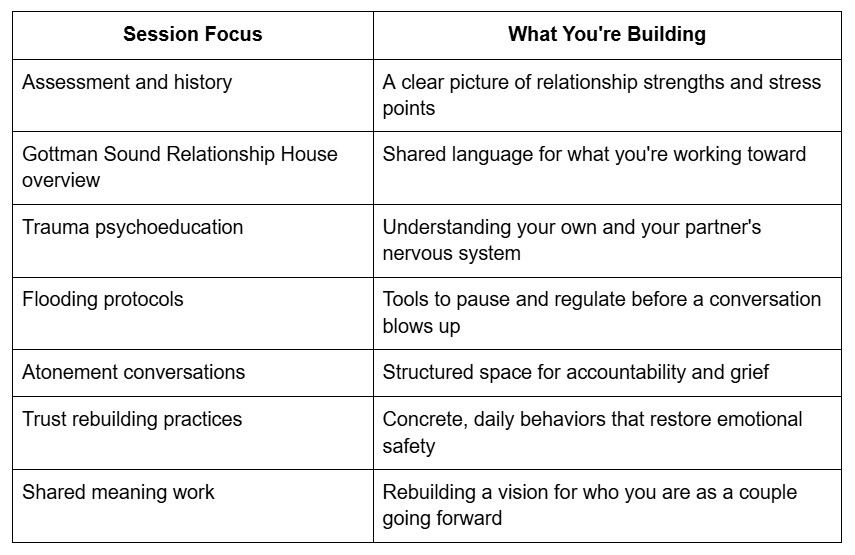
No two couples move through this the same way. Some need months in the early phases. Some arrive already more stable and can move faster. A skilled Gottman therapist who knows trauma will read where you are and adjust accordingly.
Is This Right for You?
If you're asking whether Gottman Method Couples Therapy for Trauma might be the right fit, consider whether any of these are true for you:
- Your relationship was disrupted by a significant betrayal, affair, or pattern of deception
- One or both of you is experiencing trauma symptoms: intrusive thoughts, emotional shutdowns, hypervigilance, or numbness
- You've tried regular couples therapy before and found it didn't go deep enough
- You want to stay in the relationship, but honestly don't know if you can trust again
- You're willing to do hard work, but you need a therapist who actually understands trauma
If you checked even a few of those, this approach deserves a serious look.
Frequently Asked Questions
Q: Can Gottman Method Couples Therapy work if only one of us has trauma?
Yes, and this situation is actually common. One partner may have pre-existing trauma that gets activated by the relationship, while the other is confused about why their partner reacts so intensely. A trauma-informed Gottman therapist helps both partners understand each other's nervous systems, which changes everything about how you fight, repair, and connect.
Q: How long does Gottman Method Couples Therapy for Trauma typically take?
It varies a lot depending on the severity of the betrayal and how much trauma is involved. Some couples see meaningful progress in three to six months. Others work for a year or longer, especially when there is deep PTSD or a complex relational history. Your therapist should provide you with a general treatment plan after the initial assessment.
Q: What is the difference between a regular couples therapist and a Gottman-trained therapist who specializes in trauma?
A Gottman-trained therapist has completed specific clinical training in the Gottman method, including its application to affairs and PTSD. That training teaches them to assess the relationship systematically, pace the work carefully around trauma responses, and use specific interventions rather than generic communication exercises. When trauma is involved, that difference matters a great deal.
Q: Can we do Gottman Method Couples Therapy for Trauma online?
Yes. Many Gottman therapists offer telehealth sessions, and research supports the effectiveness of online couples therapy. For couples dealing with trauma, online sessions can actually feel safer because you're in your own space. Dr. Cammy works with couples virtually, so location is not a barrier.
Conclusion: You Don't Have to Figure This Out Alone
Healing from betrayal trauma inside a relationship is one of the hardest things two people can attempt together. It is not something you should try to do with a few YouTube videos and a communication worksheet.
But it is possible. With the right therapist, the right structure, and both of you willing to show up, Gottman Method Couples Therapy for Trauma gives you an actual roadmap, not a vague promise that "things will get better."
Dr. Cammy works with couples navigating betrayal trauma, PTSD, and deep relational wounds. If you're ready to stop surviving the pain and start building something real again, reach out for a consultation today.