
Problems come up in every relationship. When couples have problems like not being able to talk to each other, fighting, or feeling distant from each other, they often think about getting professional help to fix their relationship. But when it comes to therapy, a big question comes up: what kind of therapy do we need?
People often compare Gottman therapy to other types of couples therapy. Knowing the differences can help you decide what to do in your own relationship. In this comparison of couples therapy, we'll look at how a Gottman therapist works, how traditional therapy works, and which type of therapy might be best for you.
What does it mean to go to therapy with Gottman?
Drs. John and Julie Gottman have been studying couples for over 40 years, and their work is the basis for the Gottman Method. This type of relationship counseling is one of the most popular today because it is structured, useful, and based on evidence.
A Gottman therapist helps couples with three main things: being friends, resolving conflicts, and finding meaning in their relationship. The goal isn't just to solve problems right away; it's also to build trust and closeness that will last.
Some important parts of the Gottman Method are:
- Love Maps: Getting to know each other's lives very well.
- Fondness and Admiration: Making you feel grateful and respected again.
- Turning Toward: Helping people try to connect in small, regular ways.
- Conflict management means learning how to deal with disagreements instead of getting rid of them.
- Shared Meaning: Setting goals, values, and traditions that everyone in the relationship can agree on.
What is the traditional kind of couples therapy?
Couples therapy that isn't as standardized often depends on the therapist's training, style, and way of thinking. Some therapists may use parts of behavioral therapy, attachment theory, or psychodynamic approaches, but the process is usually more like a conversation that doesn't have a set end.
- Traditional therapy for couples might include conversations about how their childhoods affect how they act now.
- Understanding how people feel and how they attach to others.
- People can talk to each other better if they talk and think about things with a therapist.
- Dealing with stress, trauma, or outside pressures that are making things hard.
A Comparison of Gottman and Traditional Couples Therapy
It's helpful to look at the pros and cons of each type of couples therapy when you compare them.
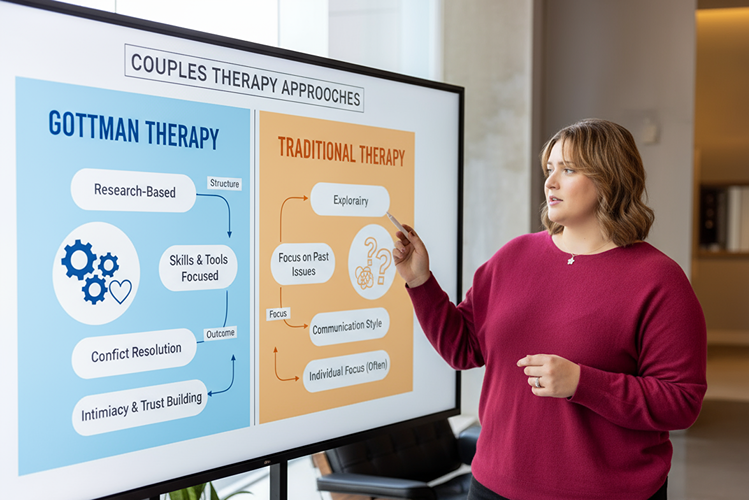
- How to Structure and Approach a Gottman Therapist: A well-organized system, based on research, has tests and clear plans. Traditional therapy is flexible, depends on the therapist's style, and is often more open-ended than structured.
- Things to Pay Attention To: Gottman therapy teaches you useful skills like how to talk to people, handle disagreements, and build trust. Traditional therapy looks at feelings, old patterns, and hidden psychological factors.
- The basis of evidence: Gottman therapy is based on years of research and clinical trials. In traditional therapy, the studies vary for each therapy type employed by the therapist.
- Best Fit For: Couples who want real tools and plans to make their relationship better can go with Gottman Therapy. Couples who want to find out more about the emotional or mental reasons for their problems can use traditional therapy.
What makes you want to see a Gottman therapist?
A Gottman therapist knows how to use tried-and-true methods to help couples get back together. This method gives you the tools you need to fix your relationship if you and your partner keep fighting, aren't close, or can't talk to each other.
A Gottman-trained counselor, for example, won't just tell you to "communicate better." Instead, they'll teach you how to deal with conflict without making it worse by using exercises like the "Softened Startup" method. The structured framework gives couples specific things they can do right away at home after therapy sessions.
The Advantages of Conventional Couples Therapy
The Gottman Method is based on research, but regular therapy can also help. A structured approach may not work for some couples, who would rather have a more open-ended process.
Partners can do the following in traditional therapy:
- Talk about old wounds that hurt you.
- Learn about the things you do without thinking.
- Know how your family's past affects how you behave in relationships.
What kind of couples therapy is best for you?
It all depends on what you want to get out of therapy:
- If you want to learn useful skills, have a clear plan, and use strategies that are easy to follow, Gottman therapy is probably the best option for you.
- If you want to talk about your feelings, think about yourself deeply, and get a treatment plan that is just for you, traditional therapy might be the best choice for you.
Couples can even benefit from using both methods together in some cases. For example, they can start with the structured Gottman Method and then move on to traditional therapy for a deeper look.
The Future of Couples Therapy: Using Both Approaches Together
Interestingly, a lot of modern therapists are using parts of both methods. They might use the Gottman Method's research-backed techniques, but they might also let people talk freely, which is common in traditional therapy.
This mixed model can help couples in two ways: it gives them useful tools to deal with their current problems and helps them understand their feelings better.
Finally, take the first step toward getting better
The most important thing is to choose to get help. You can go to a Gottman therapist who uses structured, evidence-based methods or a traditional therapist who lets you work through your problems on your own. Either way, with the right help, your relationship can change.
If you're ready to find out which method is best for you, Dr. Cammy can help you in a caring and personalized way that meets you where you are. She uses new, research-based methods to help couples reconnect, rebuild trust, and find happiness in their relationship again.
Call Dr. Cammy today to make an appointment and start working on your relationship. Don't wait until things get too hard.