
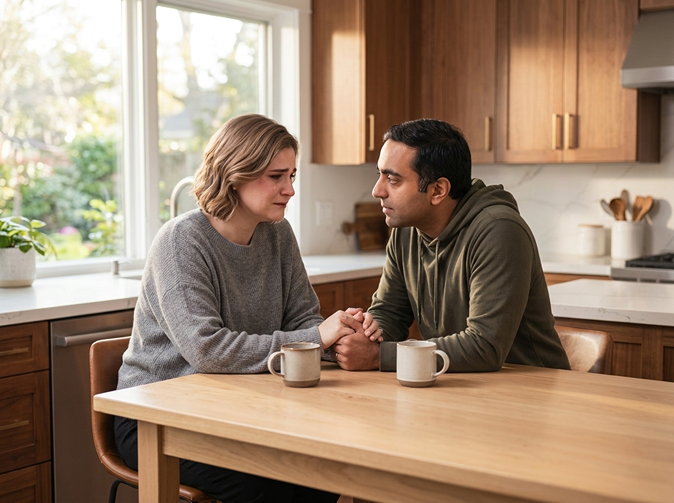
You love your partner. "You want your relationship to last. But something always goes wrong, and you can't figure out what it is.
Arguments can come from nowhere. Maybe you feel like you’re always braced. Or maybe things are fine on the outside, and you just don’t feel right inside.
Here’s something that doesn’t get talked about enough: Most relationship issues have absolutely nothing to do with your partner. They are afraid of what happened to you before your partner got here.
Research in psychology supports this. "Psychological Impact of Trauma on Mental Health: A Systematic Review and Meta-Analysis," Frontiers in Psychiatry. 2024. We analyzed 1,404 participants and found that childhood trauma directly decreases romantic relationship satisfaction, largely by affecting how people attach to others. A separate review from 2024 published in the Journal of Aggression, Maltreatment, and Trauma found nearly 44% of adolescents reported experiencing at least one form of childhood interpersonal trauma, which then impacted their ability to manage conflict in romantic relationships.
That is almost half the population entering relationships with burdens they might not even be aware of.
This post is about learning to spot it, the art of it. Because as soon as you can name what's going on, you can start to really change it.
Why Trauma Doesn't Remain in the Past
Time does not heal all wounds, and you cannot just “process and move on from” trauma. But your nervous system does not work like that.
Trauma, especially interpersonal trauma (e.g., betrayal, abandonment, emotional abuse, and neglect), is written into your body and your patterns. It impacts how safe you feel in relationships. It changes the way you understand your partner’s tone. It causes your brain to look for danger where there isn’t any.
Trauma is not simply an event that happened sometime in the past, as Dr. Bessel van der Kolk, author of The Body Keeps the Score, puts it. “It is the imprint of that experience on the mind, brain, and body.
That impression is with you in every relationship, whether you know it or not.
So if you have ever wondered why you keep repeating certain patterns or why you react to things in ways even you are surprised by, then it is worth paying attention to the answer.
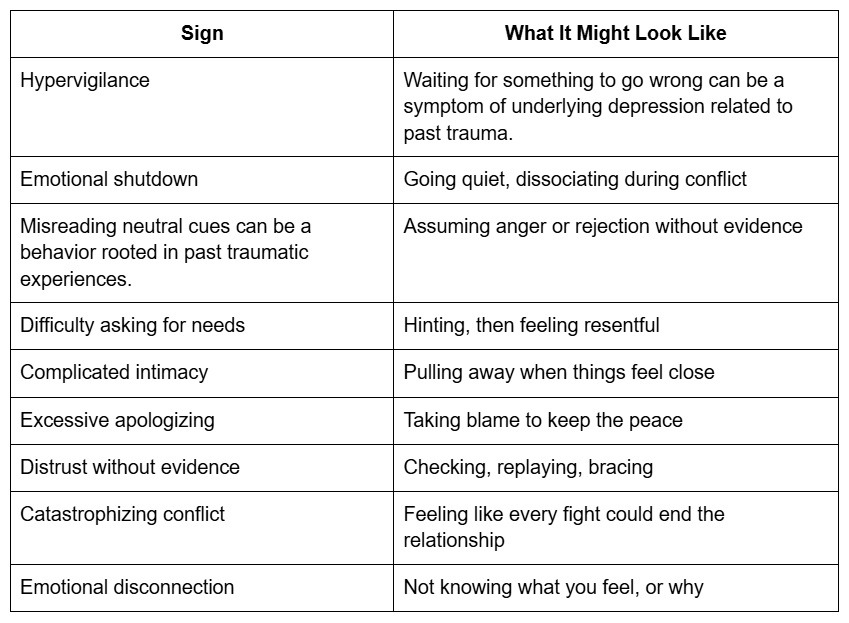
9 Signs Trauma Is Affecting Your Relationship
They may not be dramatic, in-your-face warning signs, but they can have a huge effect on mental health. They’re the quiet ones. These are the kinds you might rationalize away or not notice until someone points them out.
1. You’re always waiting for the other shoe to drop
Rather than feeling good, you become anxious that things will go well. You wait for it to come undone. You read your partner’s moods too much, or you pick fights because the tension of “things being fine” is too much to handle.
This is an over-vigilant response. At some point, your nervous system learned that safety isn’t permanent. So it keeps scanning for threats even when there are no threats.
2. You go silent in arguments
You don’t tell me how you feel; you just go quiet. You fall asleep. You leave the room, either physically or emotionally. Your partner says you're "checked out," and they're right, even if that's not what you mean.
This is known as emotional numbing and is one of the most common signs that trauma is creating relationship problems. The only way your brain knows how to protect you is to disconnect.
3. You Perceive Neutral Things As Threats
After a long day, your partner comes home quietly. You just automatically think they hate you. They reply to a text a little slower. You whirl. If your voice is sounding a little flat, something is very wrong.
This pattern is sometimes referred to as “neuroception gone haywire,” where your threat-detection system fires at neutral or positive cues because it was calibrated in an unsafe environment. This impacts your psychological well-being.
4. You find it hard to ask for what you need
You know what you need, but the words just won’t come. Or you hint at it and are annoyed when your partner doesn’t get the message. Asking for help directly feels too vulnerable, maybe even scary.
For many trauma survivors, especially those who experienced emotional neglect, asking for their needs to be met was an exercise in futility or an invitation for active punishment. So your brain learned not to.
5. Intimacy Gets Complicated, Even If You Want It
Suddenly, it is uncomfortable when someone you love and trust gets too close, physically or emotionally. You can push away when things feel good. You may not be able to participate fully in intimate moments.
This is common with people who are healing from betrayal trauma or sexual trauma. Threat gets mingled with intimacy, even when your partner is safe.
6. You Say Sorry For Everything, All the Time
You need not excuse yourself. You take the blame to keep the peace. You make yourself small, so your partner won’t get upset. You feel responsible for their feelings, and that tires you out.
Often, this behavior is a product of an environment where you were made to feel like a burden or where conflict was serious business. Keeping others calm became a survival skill.
7. You have trouble trusting, even when there's no reason to
Your partner has given you no real reason not to trust them, but you still can't let your guard down completely. You look after them. You re-listen to conversations to catch inconsistencies. You prepare for treason.
It’s one of the clearest PTSD relationship signs, and it’s painful for both people involved. That's no vice. It's a learned response that made sense once and hasn't been revised.
8. Conflict Is Like a Catastrophe
This didn't seem like an ordinary disagreement. There's a good chance this thing's over. It feels like you might not make it. This can be a common thought of those experiencing trauma. You either fight to win, or you give up and agree to anything to make it stop.
Many trauma survivors didn’t have the opportunity to resolve conflict safely as children. It got worse, it became dangerous, or it ended in abandonment. Your nervous system doesn’t know the difference between then and now.
9. You are not in touch with your feelings
You don’t always know how you feel. You know you're mad, but you don't know what for. You are numb. Or you experience things very intensely, but you cannot communicate them clearly; this can be a reaction to past psychological manipulation.
That’s called "alexithymia," and it’s common after long-term trauma. When it was not safe to express feelings, you learned to suppress or disconnect from them. That makes real emotional intimacy with a partner very difficult.
The Bigger Picture: Trauma’s Impact on Couples
When both partners are working through unprocessed trauma, which is more common than people realize, things get complex fast. The shutting down of one individual can trigger the other individual’s fear of abandonment and impact their mental health. One person’s hypervigilance is the other’s constant sense of being accused. Sometimes these dynamics are called trauma-reactive cycles, and they can feel impossible to break without outside help.
A 2025 study in the Journal of Marital and Family Therapy found that childhood trauma is actually predictive of how much couples improve in therapy. This is because the early unresolved wounds are often driving the current patterns. That doesn’t discourage me. It is really about fixing the root cause and creating real, sustainable change in the relationship.
What You Can Actually Do About It
The first step is to recognize the signs. Here’s how to get from here to better mental health.
Call it what it should be called. When you say, “I think my trauma is showing up here,” that is not weakness. It’s amazing self-awareness. Most people never put the pieces together.
Know your triggers together. Once you know each other’s triggers, you can start to build in breaks before responding. A fight becomes, "I notice I’m flooded. Can we go back to this in 20 minutes?
Find a trauma-informed therapist, ideally with training in couples. Things like EMDR (Eye Movement Desensitization and Reprocessing) can help you process the original experiences behind your current patterns. The Gottman Method can help you and your partner learn communication tools to help support each other through the healing process.
Have patience with yourself. These patterns had been established over years, sometimes even decades. Not overnight; it takes time. Consistent and supported time.
Signs Trauma Is Causing Relationship Problems: A Quick Recap
If you're recognizing yourself in several of these signs, that matters. Not because something is permanently wrong with you, but because you now have information that most people never get.
Frequently Asked Questions
Q: Can trauma from before my current relationship cause problems even if my partner is a wonderful person?
Yes, of course. Your nervous system does not know that your present partner is not the one who hurt you in the past. It responds to patterns and cues, not to people. That’s the reason why someone can have a really great partner and still struggle. This is about updating what your nervous system understands is safe now.
Q: What is the difference between normal relationship stress and trauma that affects relationships?
Normal stress is usually situational and diminishes when the situation changes. Trauma responses are persistent, disproportionate to what is happening, and don’t resolve on their own. If you notice the same patterns in more than one relationship or feel that you are reacting to something bigger than the here and now, it may be a sign of psychological trauma.
Q: My partner has betrayal trauma from a previous relationship. What does that mean for us now?
Betrayal trauma, especially from a romantic partner, can leave very specific wounds around trust, safety, and intimacy that affect one’s mental health. Your partner may find it hard to believe you're not hiding something, even when there's no evidence you are. They can become hypervigilant about your availability or your transparency. A little patience, consistency, and, ideally, couples therapy with a betrayal trauma specialist can go a long way.
Q: Does EMDR therapy work for trauma that’s impacting my relationship?
Yes. EMDR is one of the most evidence-based treatments for trauma, and it helps your brain to reprocess difficult memories so that they lose their emotional charge. The automatic relationship responses that come from the root memory often change, too, when the root memory loses its grip. Many people find that their triggers and their ability to be present in their relationships change after EMDR.
Conclusion: You Deserve a Relationship That Feels Safe
Seeing the signs that trauma is causing relationship problems is not a way to give yourself another reason to feel broken. It’s about getting clarity, understanding why some things feel so hard, and having a real path forward.”
You don’t have to be white-knuckling through the same cycles. “The patterns may change. The triggers can be addressed. You can feel safer in the relationship. You can feel safer in yourself.
Dr. Cammy is trained in just this kind of work, mixing EMDR trauma therapy with the Gottman Method for couples, so you’re healing the past while building something better in the present.
If you’re ready to stop just managing and start actually healing, contact Dr. Cammy today to book a consultation. Your relationship and your nervous system need that kind of attention.
Related Posts You Might Want to Read
- The Hidden Cost of Ignoring Trauma in Relationships
- Do You Need Trauma Therapy or Couples Counseling? Here's How to Know
- From Surviving to Thriving: Couples Who Healed Together After Traumatic Experiences