
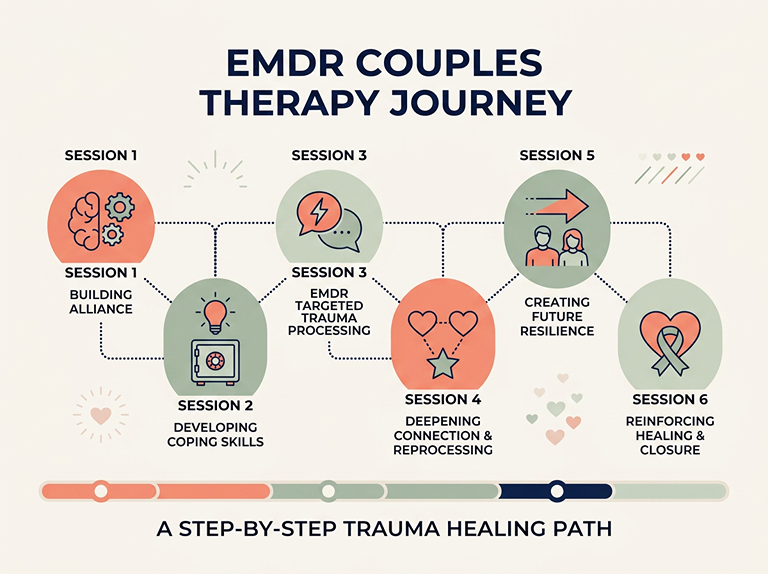
The Moment Everything Shifted (And Why Normal Therapy Wasn't Enough). You found out. Or maybe you've known for a while, and you're still stuck in that same loop, that same sick feeling in your chest when you look at your partner. You're trying to talk about it, maybe even going to couples therapy, but every session feels like wading through mud. You get close to something real, and then one of you shuts down or gets flooded with emotion, or the conversation goes sideways.
That's not a character flaw. That's your nervous system doing exactly what it was designed to do: protect you.
Betrayal trauma hits differently. It's not just hurt feelings. It's closer to what soldiers experience after combat. Your brain literally stores the discovery of betrayal as a traumatic memory, and until that memory is processed, you'll keep reliving it.
That's where EMDR therapy for couples trauma comes in.
What Is EMDR, and Why Does It Work for Relationship Trauma?
EMDR stands for Eye Movement Desensitization and Reprocessing. It was originally developed in the late 1980s by Dr. Francine Shapiro for PTSD treatment, and it's now one of the most well-researched trauma therapies available. The World Health Organization recommends it. So does the American Psychological Association.
But here's what most people don't know: it's not just for war veterans or accident survivors. It works powerfully for relationship trauma, too.
The way it works is actually pretty fascinating. When something traumatic happens, your brain sometimes can't fully process the memory. It gets stuck and frozen, and every time something reminds you of the event, your brain fires as if it's happening right now. That's why you might feel your heart race when you see a notification on your partner's phone, even six months later.
EMDR uses something called bilateral stimulation, which can be guided eye movements, gentle tapping, or alternating sounds, to activate your brain's natural information processing system. Think of it like helping your brain finally digest a meal it's been choking on.
As the EMDR International Association explained in a 2026 article, "unresolved trauma can derail couples sessions entirely" because partners become flooded, shut down, or leave sessions altogether when difficult material comes up. EMDR creates stability first, so real relational work can happen.
Research backs this up. According to published clinical data, EMDR therapy can resolve a single-incident trauma memory in three to six sessions in 77 to 100% of cases. That's meaningful when you're trying to rebuild a relationship and can't afford to stay stuck.
EMDR Therapy for Couples Trauma: What Actually Happens in a Session?
This is the part most people don't know to ask about, and it matters a lot.
EMDR follows an eight-phase protocol. When it's woven into couples work, it doesn't mean both of you are doing eye movements at the same time while holding hands. It's more structured and thoughtful than that.
Here's a simplified look at the phases:
- History and Treatment Planning: Your therapist gets to know both of you, what happened, what each of you is carrying, and what the primary targets for processing will be.
- Preparation: Each of you learns how to stabilize your nervous system. This is non-negotiable. You need a foundation before touching the painful stuff.
- Assessment: You identify specific memories that are most charged. For betrayal, the trigger is often the moment of discovery, a particular conversation, or a recurring intrusive image.
- Desensitization: This phase is where bilateral stimulation is used while you focus on the distressing memory. The emotional intensity starts to come down.
- Installation: You replace the old negative belief ("I'm not enough") with something more accurate and adaptive.
- Body Scan: You check for lingering tension or distress in your body.
- Closure: Every session ends with grounding, so you leave feeling stable, not raw.
- Re-evaluation: The next session begins by checking in on what shifted.
One powerful variation in couples EMDR is when one partner processes a memory while the other sits as a witness. Research published through the American Counseling Association found that when the offending partner witnesses the betrayed partner's trauma resolution through EMDR, it can produce "newfound awareness" and deep empathy that strengthens emotional intimacy in ways talking alone rarely achieves.
Who It Helps (And Who It Doesn't)
Let's be honest here, because not everything works for everyone.
EMDR therapy for couples trauma is especially helpful when:
- One or both partners are experiencing intrusive thoughts, flashbacks, or hypervigilance related to the betrayal
- Couples therapy sessions keep derailing because someone gets emotionally flooded
- There's a genuine desire to repair, but the nervous system keeps getting in the way
- The betrayed partner is stuck in a loop of "I keep trying to forgive, but I can't move forward."
- The partner who caused harm is carrying so much shame that they can't show up for repair work
It may not be the right starting point when:
- There's ongoing deception or no real accountability yet
- One or both partners are not committed to the process
- Safety in the relationship hasn't been established
- Either partner has active substance use or untreated mental health crises that need to be addressed first
A skilled couples EMDR therapist will assess all of this with you before starting. You don't have to figure it out alone.
A 6-Session EMDR Couples Session Starter Plan
This isn't a rigid formula. Think of it more as a map. Every couple is different, and your therapist will adjust based on what's coming up. But this gives you a realistic picture of what the early phase of couples' EMDR often looks like.
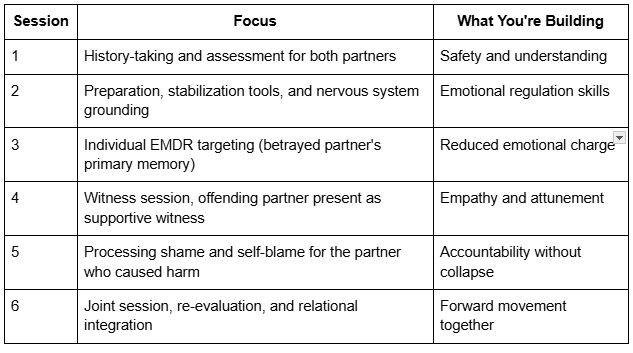
A few notes on this plan:
- Sessions 3 and 5 may span multiple appointments depending on complexity.
- Some couples benefit from 1 to 2 individual EMDR sessions before doing any joint work.
- This is a starter plan, not a finish line. Healing relationship trauma usually takes longer than six sessions total, but these six can create significant early movement.
The Reactions of Couples Who Have Done This
You probably want to know: Does it actually work? Here's what the research and clinical experience consistently show.
Couples who engage in EMDR after betrayal often report greater emotional clarity, less reactivity when discussing the betrayal, and a restored ability to make decisions about the relationship from a clear-headed place rather than from raw panic.
One clinical finding that stands out is that as trauma symptoms reduce, both partners become better able to access their actual feelings about the relationship rather than their trauma responses. That's huge. Many couples believe they have "tried everything," but in reality, they have only attempted various solutions while one or both partners' nervous systems were in survival mode.
That's not a relationship problem. That's a trauma problem, and it can be treated.
What EMDR for Relationship Trauma Is NOT
This is worth saying plainly:
EMDR is not a relationship fixer by itself. It doesn't tell your partner what to do or guarantee reconciliation. It doesn't mean you have to stay. It also doesn't mean you have to leave.
What it does is reduce the noise so you can hear yourself think. And when both of you can do that, you get to make real decisions from a real place.
It also doesn't mean you'll be reliving the worst moments in every session. EMDR is actually designed to prevent re-traumatization. You recall elements of a memory while staying grounded in the present. It's not the same as retelling the story in graphic detail, which is something many betrayal trauma survivors are understandably terrified of doing.
Why the Timing Matters
One thing that often surprises couples is how much timing matters with EMDR for relationship trauma. Starting too early, before there's any sense of safety or stabilization, can actually increase distress. Starting too late, after years of avoidance and disconnection, can mean there's more to untangle.
The sweet spot is this: when both partners have made a genuine choice to try, when the therapist has established trust with both people, and when at least some basic grounding tools are in place. That's when EMDR moves fastest.
Neurobiological research confirms that betrayal disrupts the brain's attachment and safety systems for both partners. The person who was betrayed and the person who did the betraying are both dysregulated, just in different ways. EMDR addresses both.
Is EMDR Therapy for Couples Trauma Right for You?
Ask yourself these questions:
- Have you been going to couples therapy but feel like you're not getting traction?
- Does one of you shut down or escalate every time the betrayal comes up?
- Are you struggling with sleep, intrusive images, or a constant low-grade sense of dread?
- Do you find yourself wanting to move forward but feeling physically unable to?
If you answered yes to more than one of those, EMDR therapy for couples trauma is worth a serious conversation with a trained therapist.
FAQ: Your Real Questions About Couples EMDR
Q: Does EMDR make you relive the trauma all over again?
No. EMDR is specifically designed so you recall aspects of a distressing memory while staying grounded in the present moment. You're not transported back. You remember, but from a safer distance. Most clients describe the sensation as the memory losing its grip rather than intensifying.
Q: Can we do couples EMDR if we're not sure we want to stay together?
Yes, and actually, this is one of the best times to try it. EMDR reduces the noise and reactivity so both partners can make clearer decisions. It doesn't push you toward staying or leaving. It helps you figure out what you actually want when you're not in survival mode.
Q: How is EMDR different from regular couples therapy?
Regular couples therapy primarily works with thoughts, communication patterns, and relational dynamics. EMDR works at the level of the nervous system, targeting how traumatic memories are stored in the brain. They complement each other well, but EMDR addresses the physiological layer of trauma that talk therapy alone often can't reach.
Q: How many sessions does EMDR for relationship trauma typically take?
It varies. Some people notice significant shifts in three to six sessions for a specific traumatic memory. For complex betrayal trauma with multiple layers, including childhood wounds that got activated, the process takes longer. The six-session starter plan above gives you a foundation. Most couples benefit from ten to twenty sessions total when combining EMDR with relational work.
Conclusion: You Don't Have to Keep Treading Water
Betrayal trauma has a way of making you feel like you're stuck in the same moment over and over. Like, no matter how much you talk about it, nothing shifts. That's not a weakness. That's what unprocessed trauma does.
EMDR therapy for couples trauma offers something different. It works with your brain's own healing capacity, not against it. It creates space for both of you to process what happened at the level where it actually lives: your nervous system, your sense of safety, and your beliefs about yourself and your relationship.
You deserve more than just surviving this. And so does your relationship.
If you're ready to stop going in circles and start actually moving, Dr. Cammy works with couples navigating betrayal trauma using EMDR, Gottman methods, and a deeply individualized approach.
Book your first session with Dr. Cammy at drcammy.com. Real healing is possible. Let's find out what it looks like for you.
Blog Posts Worth Reading Next
- Do You Need Trauma Therapy or Couples Counseling? Here's How to Know
- The Hidden Cost of Ignoring Trauma in Relationships
- From Surviving to Thriving: Couples Who Healed Together After Trauma